Production
How Many Scenes per Minute in an Explainer Video? A Pacing Guide With the Math

By the StickTale team
· 10 min read
A narrated explainer works well at about 12 scenes per minute: one new picture every 5 seconds, which at a typical 150 words a minute is about 12 words, or one sentence, per picture. Go faster (3 to 4 seconds a scene) during escalation and slower (6 to 8 seconds) on a reveal or a busy diagram, and leave a short pause before every reveal. Below is how those numbers are derived, a full pacing table from 45 seconds to 12 minutes, and a worked Short timed line by line.
How many scenes per minute should an explainer video have?
For a narrated stick-figure explainer, plan on about 12 scenes per minute, one every 5 seconds. That is the rhythm of the faceless history and science channels the format comes from: one calm voice, one new picture per sentence, slow camera motion in between.
Promotional animation runs faster. The studio Vidico says 16 to 18 illustrated scenes per 60 seconds worked best in its tests on Vimeo and paid YouTube ads, which is one scene every 3.3 to 3.75 seconds. Ads pack a short message into a short slot. An explainer has to land an idea the viewer didn't know, and that needs a little more time per picture.
Real numbers from a finished Short show the same rhythm. A 46-second StickTale Short on why Moroccans pour tea from high up has 8 scenes, which is 5.75 seconds per scene.
| Style | Seconds per scene | Scenes per minute | When it fits |
|---|---|---|---|
| Fast promo animation | 3.3 to 3.75 | 16 to 18 | Ads and product promos with one message. |
| Escalation stretch | 3 to 4 | 15 to 20 | A burst of examples or a rising list, for 10 to 20 seconds. |
| Standard narrated explainer | 5 | 12 | The default for Shorts and most long-form scenes. |
| Calm documentary | 6 to 7 | about 9 to 10 | Slower reads, long-form history, reflective endings. |
| Hold | 8 or more | under 8 | A map, a diagram, a number the viewer needs to read. |
How many words per minute should narration be?
Scene count follows narration, so start with speaking rate. Baruch College's Tools for Clear Speech puts the average English speaker at about 150 words per minute, and suggests about 140 for speakers who need to be more intelligible. It also notes that presentations usually call for a slightly slower rate than conversation.
So 150 words a minute, or 2.5 words a second, is a safe planning number for a calm narrator. A gripping or funny read may run faster, and a documentary read slower. The point is not to hit 150 exactly, but to know your own number so the math below works for you.
- Take any 100 words of your script.
- Read them aloud at the pace you'll actually use, or play the voiceover, and time it.
- Divide 100 by the seconds, then multiply by 60. 40 seconds means 150 words a minute; 45 seconds means about 133.
- Divide that by 60 to get words per second, and use it in place of 2.5 everywhere below.
How many words should each scene have?
Multiply seconds per scene by words per second. At 5 seconds and 2.5 words a second, that is 12.5 words, so about 10 to 15 words per scene. In practice that is one sentence, which gives you the most useful rule in this guide: one sentence, one picture.
When a sentence runs past about 20 words, it needs two pictures or a cut. When two short sentences say one thing, they can share a picture. The test is whether the picture could change halfway through the sentence without confusing anyone. If yes, split it.
| Seconds per scene | At 130 wpm | At 150 wpm | At 170 wpm |
|---|---|---|---|
| 3 | 6.5 | 7.5 | 8.5 |
| 4 | 8.7 | 10 | 11.3 |
| 5 | 10.8 | 12.5 | 14.2 |
| 6 | 13 | 15 | 17 |
| 8 | 17.3 | 20 | 22.7 |
Pacing table: scenes and words from 45 seconds to 12 minutes
Here is the whole plan in one table. Words assume 150 words a minute minus pauses: about one 0.75-second beat every 30 seconds, which takes 2.5% off the time. Pictures assume one every 5 seconds for Shorts and 5 to 6 seconds for long-form, where you can afford more holds on maps and diagrams.
YouTube now classifies square and vertical videos up to three minutes as Shorts, so the Short rows stop at 3 minutes. For chapters, YouTube requires at least three timestamps, starting at 0:00, each at least 10 seconds long, so the chapter column starts at 5 minutes.
| Length | Words | Pictures | Words per picture | Structure |
|---|---|---|---|---|
| 45 s Short | about 110 | 9 | 12 | Hook, 3 beats, payoff |
| 60 s Short | about 145 | 12 | 12 | Hook, 4 beats, payoff |
| 90 s Short | about 220 | 18 | 12 | Hook, 2 twists, payoff |
| 3 min Short | about 440 | 36 | 12 | Hook, 3 mini-stories, payoff |
| 5 min video | about 730 | 50 to 60 | 12 to 15 | 3 chapters of about 100 s |
| 8 min video | about 1,170 | 80 to 96 | 12 to 15 | 4 chapters of about 2 min |
| 10 min video | about 1,460 | 100 to 120 | 12 to 15 | 5 chapters of about 2 min |
| 12 min video | about 1,750 | 120 to 144 | 12 to 15 | 6 chapters of about 2 min |
Worked example: a 44-second Short timed line by line
Here is a short explainer on why the ocean is salty, built from NOAA's explanation and the USGS answer. Each line is one picture. The first draft had lines 5 and 6 as one 25-word sentence, about 10 seconds on a single image, so it was split into a setup and a payoff.
The script is 105 words, which is 42 seconds at 2.5 words a second. Two pauses add about 1.7 seconds, for a total near 44 seconds and an average of 4.9 seconds per picture.
Why is the ocean salty?
- RAIN?The ocean is salty because of rain.
- Rain is slightly acidic, so over time it eats away at rocks on land.
- IONSThat frees up tiny dissolved bits of mineral called ions.
- Streams carry the ions to rivers, and rivers carry them to the sea.
- There's a second source, hidden under the sea.
- VENTSSeawater seeps into cracks in the seafloor, gets heated by magma and comes back out of vents.
- NaClThe two most common ions? (beat) Chloride and sodium. That's table salt.
- 3.5%Today, about three and a half percent of seawater's weight is dissolved salt.
- (beat) So the next time you taste the sea, you're tasting rain-worn rock.
| Scene | Words | Seconds | Note |
|---|---|---|---|
| 1 | 7 | 2.8 | Short hook, fast first cut. |
| 2 | 14 | 5.6 | Standard scene. |
| 3 | 10 | 4.0 | New term gets its own picture and label. |
| 4 | 13 | 5.2 | Standard scene. |
| 5 | 8 | 3.2 | Setup line, split from scene 6. |
| 6 | 17 | 6.8 | Longest scene: a diagram the viewer needs to read. |
| 7 | 11 | 4.4 + 0.7 | Pause after the question, before the answer. |
| 8 | 13 | 5.2 | A number on screen as a label. |
| 9 | 12 | 1.0 + 4.8 | Pause before the callback to "rain." |
Where should you pause in an explainer?
Pauses are part of pacing, not gaps in it. Baruch's guide notes that short pauses between thoughts are normal in spoken American English, but too many make speech harder to follow. In an explainer, save them for the moments where the viewer needs a beat to think, or to want the answer.

A pause costs words. At 2.5 words a second, a 0.75-second beat is about two words, and a 1-second beat is two and a half. Four beats in a 45-second Short cost about 8 words, so cut them from setup lines, not from the reveal.
- Before a reveal: 0.5 to 1 second after the question, before the answer. The most valuable pause in the script.
- After a number: about half a second, so "3.5 percent" registers before the next sentence.
- Before the callback: about a second before the last line, so the ending feels like an ending.
- Not after every sentence: constant pauses read as slow narration, and viewers swipe.
When should scenes be shorter or longer?
Five seconds is an average, not a metronome. The scene length should follow what the picture asks of the viewer. A simple action reads in two seconds; a map with three labeled cities needs seven.
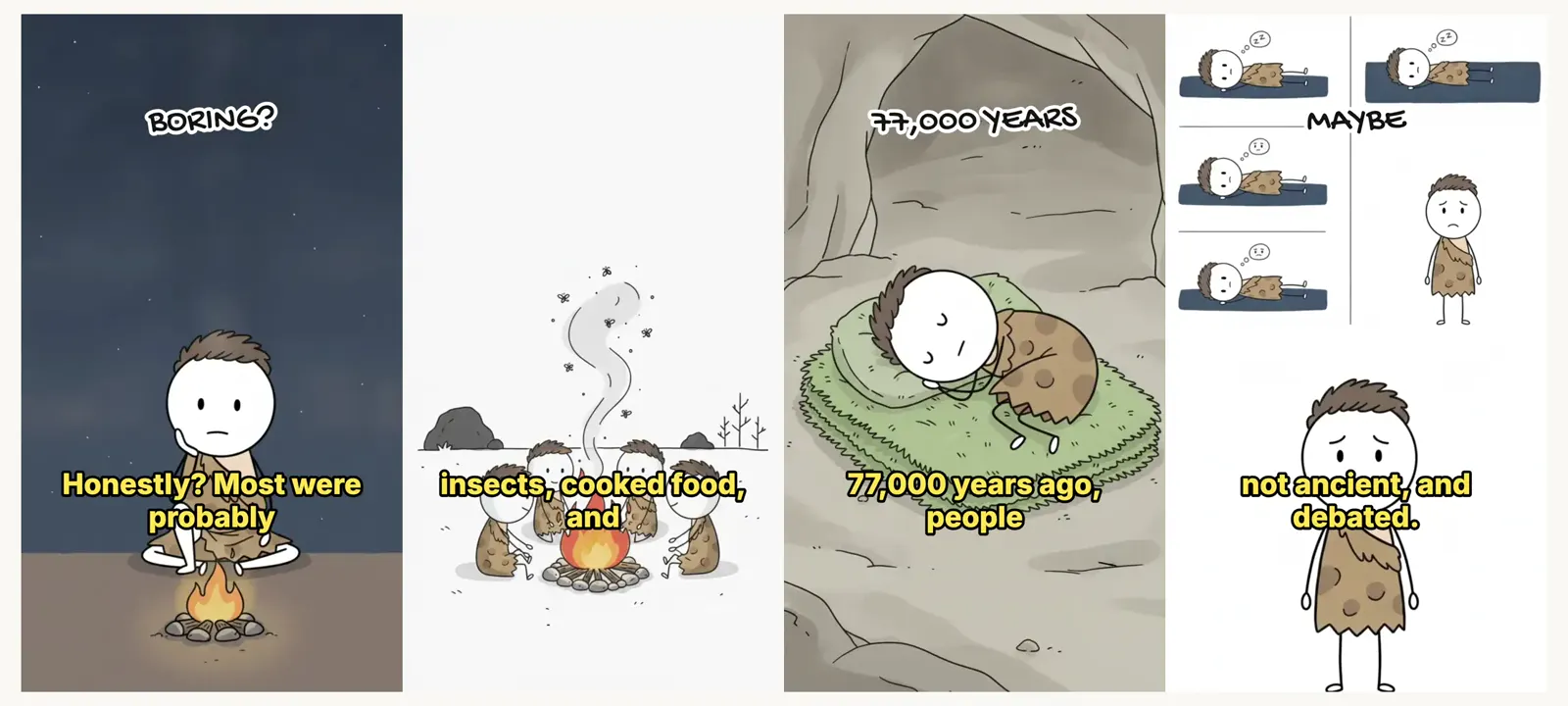
The four frames shown here, from a real Short on how ancient humans spent the night, show the kinds of pictures that need different times: a simple mood shot, a group scene, a picture with a number to read, and a busier panel with several sleeping figures to take in.
| Picture shows | Seconds | Why |
|---|---|---|
| A single action or reaction | 2 to 4 | Read at a glance; good in escalation. |
| A character in a setting | 4 to 6 | The standard explainer picture. |
| A number or label to read | 5 to 7 | Viewers read the label, then listen. |
| A map, diagram or comparison | 6 to 9 | Several things to find and connect. |
| The final payoff | 5 to 8 | Room for the callback to land. |
How do you pace a long-form explainer?
Long videos fail on pacing differently. A Short loses viewers in the first seconds; a 10-minute video loses them in the middle, when the topic stops changing. Use chapters of about two minutes, and give each one its own small hook and its own payoff, so the viewer gets a reward every two minutes, not only at the end.
Inside a chapter, use the same one-sentence-per-picture rhythm, but allow more holds for maps and timelines. If you script long-form videos, our guide to writing an explainer video script covers the chapter structure, and faceless YouTube channels often alternate long videos with Shorts cut from the same research.
- Split the topic into chapters of 90 seconds to 2.5 minutes, each answering one sub-question.
- Open each chapter with a one-line hook that raises its sub-question.
- Count words per chapter: 2 minutes at 150 words a minute is about 290 words after pauses.
- Plan one picture per sentence, and mark the holds for maps, numbers and diagrams.
- End each chapter with a small payoff and a line that points to the next question.
Questions
How long should each scene be in an explainer video?
About 5 seconds on average for a narrated explainer, which matches one sentence of 10 to 15 words at a normal speaking pace. Go shorter, 3 to 4 seconds, for quick escalation, and longer, 6 to 9 seconds, for maps, diagrams and numbers the viewer needs to read.
How many words is a 1-minute explainer script?
About 140 to 150 words at a typical pace of 150 words a minute, after leaving room for a few short pauses. A slower documentary read at 130 words a minute fits about 125 words.
How many words is a 10-minute YouTube video?
About 1,400 to 1,500 words at 150 words a minute. Time your own narration on 100 words first; at 130 words a minute a 10-minute video is closer to 1,300 words.
How many scenes is a 60-second YouTube Short?
About 12, one every 5 seconds. Fast promotional animation can use 16 to 18 per minute, but a narrated explainer usually needs a little more time per picture so each idea lands.
Should every sentence get a new picture?
Most should. One sentence per picture keeps the visuals in step with the narration. Split sentences longer than about 20 words into two pictures, and let two very short sentences share one picture when they make a single point.
Make your first stickman video
StickTale is in private beta. Join the waitlist and we’ll send your invite as soon as a spot opens.