Growth
Why Stickman Explainer Videos Go Viral (and What to Copy)

By the StickTale team
· 10 min read
Stickman explainers go viral because they remove everything that competes with the idea. A curiosity title promises a specific answer, the first line opens a question the viewer needs closed, a new simple picture appears every few seconds, and one recurring character and one calm narrator make the channel instantly recognizable. Because each video is cheap to make, creators can post often and learn which topics hit.
What makes the stickman explainer format work?
No single trick makes these videos spread. It is a stack of small, deliberate choices, each removing a reason to swipe away. The table is the whole format on one screen; the rest of this guide unpacks each row. If a row is missing from your video, you can usually point to the second where viewers leave.
| Ingredient | Why it works | How to apply it |
|---|---|---|
| Stick figure art | Read in a glance, so attention goes to the idea | One character, one prop, plain background |
| Curiosity title | Names a gap between belief and fact | One odd, concrete detail framed as a question |
| Cold-open hook | No intro to skip, the strange part comes first | Start mid-fact; no "today we'll talk about" |
| Open loop | An unanswered question pulls viewers through | Ask it in line 2, answer it in the last 10 seconds |
| Picture every ~5 seconds | Resets attention before it drifts | One idea per picture, readable with the sound off |
| Recurring character | Recognizable in a crowded feed | Fixed head, proportions and one accessory |
| Calm narrator | Lets absurd facts land; builds trust | Steady pace, a pause before each reveal |
| Payoff with a callback | Feels complete, invites a rewatch or follow | Echo the first line in the last one |
| Low cost per video | More tests, faster learning | Keep production to minutes, not days |
Why do simple drawings hold attention better than detailed ones?
A realistic scene asks the viewer to parse faces, lighting, clothing and background before they get to the point. A stick figure with a round head and two dot eyes is read in a fraction of a second. That spare style is not a budget compromise. Every bit of attention goes to the one thing the picture is there to show, whether that is a courtroom, a sundial or a brain with an arrow pointing at one part.
There is also a built-in joke. A crude drawing next to a serious subject, like the fall of an empire told by a figure with no nose, feels friendly instead of like homework. And with no specific age or nationality, one stick figure plus a hat can play a Roman soldier or a person awake at 3 a.m.
What kind of title gets the click?
Look at what performs in this niche and the titles share a pattern: an odd, concrete detail framed as a question or a claim. "Why did medieval courts put animals on trial?" names something that seems impossible and promises to explain it. "Medieval justice explained" promises nothing in particular.
Strong titles pass three tests: specific enough to picture, a gap between what the viewer believes and what the title says, and a video that fully pays it off. A title that over-promises gets the click and loses the viewer.
- Weak: "The history of taxes". Strong: "The emperor who taxed pee".
- Weak: "How memory works". Strong: "Why you forget things the moment you walk through a door".
- Weak: "Facts about Venus". Strong: "A day on Venus is longer than its year".
- Weak: "The history of time". Strong: "Why does an hour have 60 minutes?"
How do the hook and open loop keep people watching?
On Shorts there is no title screen and no intro. The first spoken line is the hook. YouTube even measures this moment: in Studio, Shorts get a "stayed to watch" metric, which YouTube's help page on content performance defines as the percentage of times viewers stayed past the initial seconds of a Short. Successful explainers start in the middle of the strangest fact, then immediately open a loop: a question the video promises to answer later.
The loop carries viewers through the middle. Each new fact should tighten the question or add a new one, and the answer comes near the end with a callback to the first line, so the video feels complete. Our guide to writing hooks for explainer Shorts has nine first-line formulas to start from.
How often should the picture change?
The visual rhythm of the format is a new still roughly every five seconds, with slow camera motion on each. That cadence resets attention just before it drifts. The four frames below are consecutive scenes from a real 45-second StickTale Short, "Why did ancient Romans pee in their laundry?". Each one shows a different idea: urine poured on laundry, a pot collecting it on the street, a worker stomping clothes in a tub, and an emperor raking in coins from the tax.
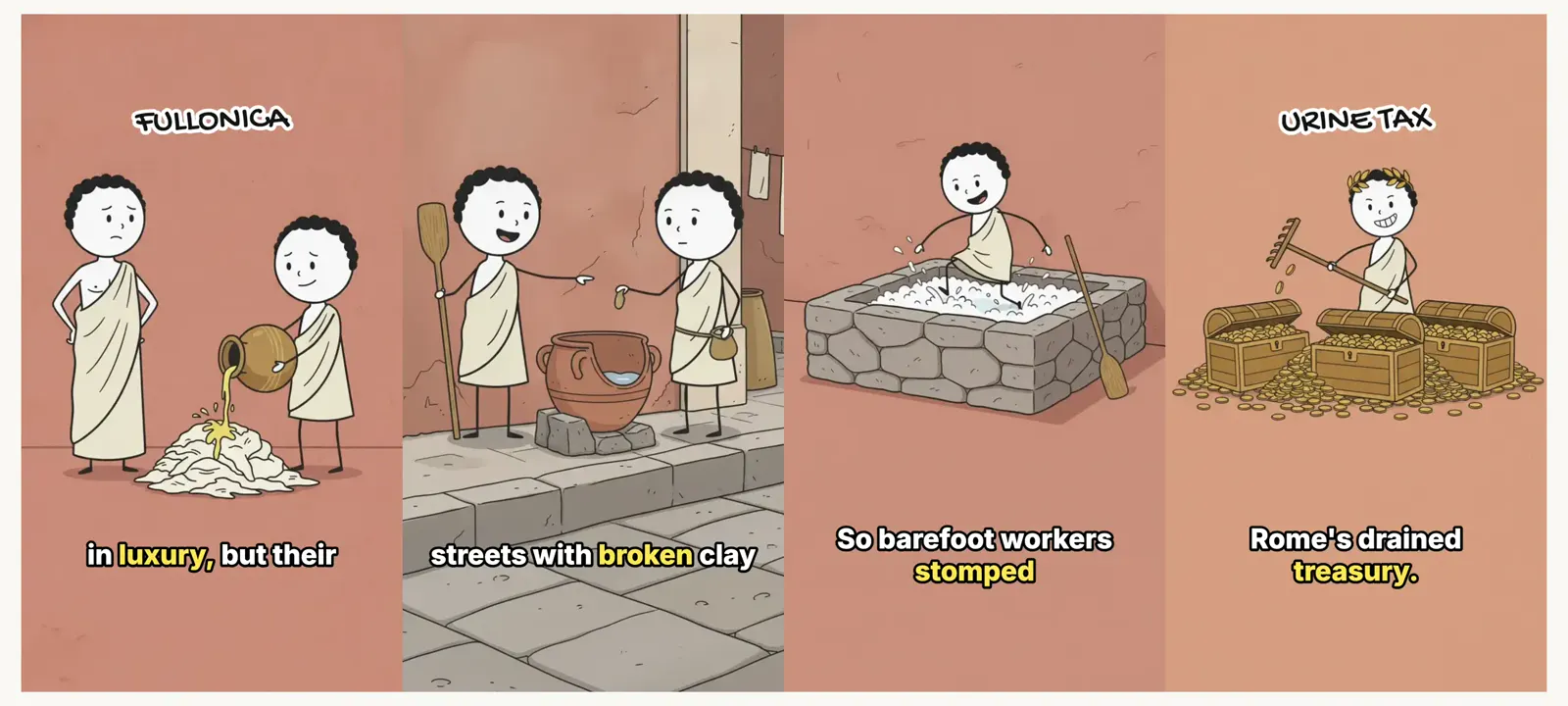
The pictures are not decoration. Every frame should carry information the narration is about to use or has just said: a label with a date, a diagram, a reaction that tells you how to feel about a fact. A random image every five seconds keeps the rhythm but loses the meaning.
You can plan the picture count before you write. Time your narrator reading a paragraph; a calm read is often around 150 words a minute, which is 2.5 words a second. At one picture every 5 seconds, that is about 12 words of narration per picture, which is one short sentence. The table shows what that means for common lengths.
| Video length | Narration words | Pictures needed | Words per picture |
|---|---|---|---|
| 45 seconds | ~112 | 9 | ~12 |
| 60 seconds | ~150 | 12 | ~12 |
| 3 minutes | ~450 | 36 | ~12 |
| 8 minutes | ~1,200 | 96 | ~12 |
| 10 minutes | ~1,500 | 120 | ~12 |
Teardown: where every retention device sits in a 50-second Short
Here is a sample Short written in the format, with each line labeled by the job it does and the approximate time it starts. The facts come from Scientific American's explainer on how time was divided. It runs about 130 words, so at a calm pace it lands near 50 seconds and needs about ten pictures.
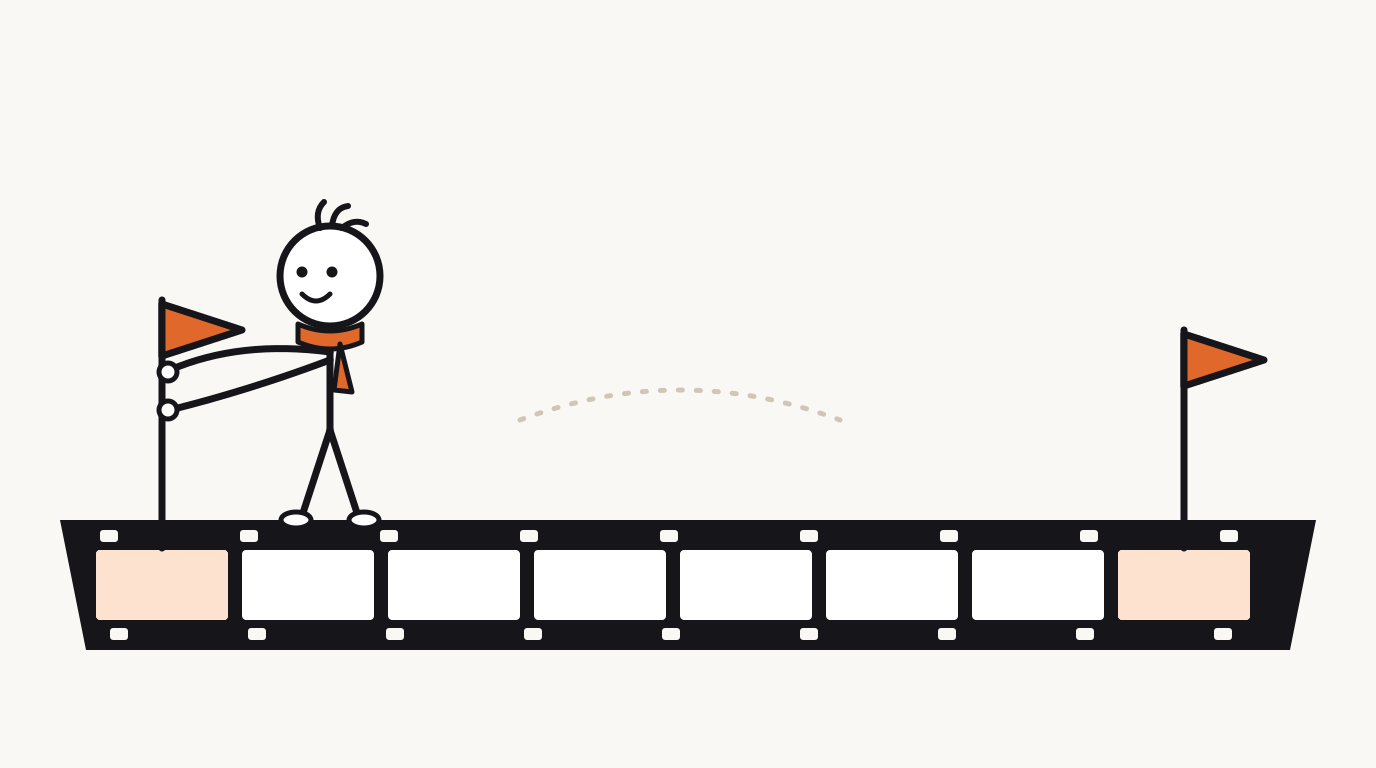
This is the same beat order StickTale's script planner uses (hook, open loop, escalation, twist, payoff that calls back to the hook), so you can study it here and see it applied when you make your own stickman explainer.
- Hook (0:00): a claim about the viewer's own phone, with a surprising age. No greeting.
- Open loop (0:06): an honest unknown that the ending returns to.
- Escalation (0:15 to 0:29): each line adds a number the viewer can picture: a divisor chart, a sundial split in 12.
- Twist (0:30): minutes started on maps, not clocks.
- Payoff (0:42): repeats "4,000-year-old math" and "why it's sixty", so the loop closes where it opened.
Why does an hour have 60 minutes?
- 0:00 HOOKEvery minute on your phone is a leftover from math that is about 4,000 years old.
- 0:06 OPEN LOOPAnd the strange part? Nobody knows for sure why they picked sixty.
- 0:11 SETUPThe Sumerians counted in sixties. Babylonian astronomers inherited the habit.
- 0:15 ESCALATIONSixty divides evenly by 2, 3, 4, 5 and 6. Also by 10, 12, 15, 20 and 30. Ten can't do that.
- 0:24 ESCALATIONThen Egypt split daylight into 12 parts, and the night into 12 more. Hello, 24 hours.
- 0:30 TWISTBut minutes weren't made for clocks. Around A.D. 150, Ptolemy used sixtieths to slice up degrees on a map.
- 0:38 TWISTClocks didn't even show minutes until the late 1500s.
- 0:42 PAYOFFSo every time you check the time, you're reading a map grid built on 4,000-year-old math. And we still don't know why it's sixty.
Why does a recurring character matter so much?
Faceless channels still need a face, and in this niche it is the stick figure. The same character across dozens of videos does what a host does on a camera channel: it makes the channel recognizable in a crowded feed. Each channel below is identifiable from a single frame.
The numbers also show two different paths. Sam O'Nella Academy has the fewest uploads and the highest views per video, each one packed with original jokes. History Matters has the fewest subscribers of the three but the most total views, built on steady volume of short questions. Both depend on a format cheap enough per video that the creator can keep going.
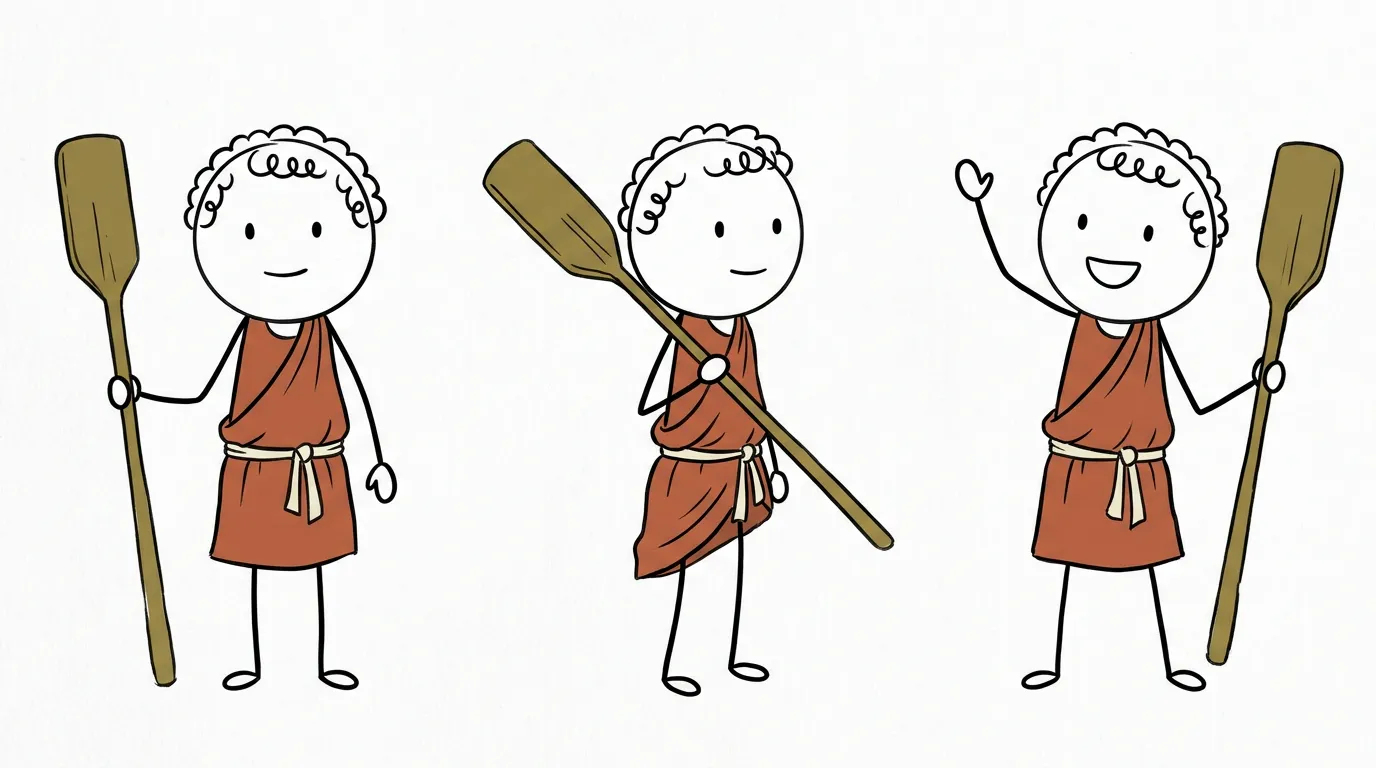
Design your character once and protect it: fixed head shape, one accessory, consistent proportions. A character that changes between scenes costs you that recognition, which is why StickTale draws a reference sheet first, like the one below, and illustrates every scene from it.
| Channel | Style | Joined | Subscribers | Videos | Total views | Views per video |
|---|---|---|---|---|---|---|
| Sam O'Nella Academy | Crude hand-drawn history and science | Jun 2016 | 4.81M | 69 | 771,493,660 | ~11.2M |
| Casually Explained | Stick figures, deadpan voice | Dec 2015 | 4.22M | 134 | 553,995,797 | ~4.1M |
| History Matters | Short history questions, simple drawings | Aug 2015 | 1.92M | 397 | 808,047,157 | ~2.0M |
Why does calm narration work better than hype?
The dominant voice in the niche is calm, a little dry, and confident: a friend explaining something, not an announcer selling it. Underselling makes absurd facts funnier, and a steady voice builds trust when viewers need to believe what they hear.
It also costs the viewer less effort to follow. A pause before a reveal does more than a raised voice. In the teardown above, "Ten can't do that" lands because it is said flatly.
Why does low production cost help a channel grow?
For a new channel, volume has a specific benefit: you learn faster. You cannot know in advance which topics, title patterns or lengths your audience wants. Two or three Shorts a week for 13 weeks is 26 to 39 tests, enough to see which ideas get past the first seconds and which do not.
Run it like an experiment. Keep a simple sheet with the title pattern, the hook type, the length and the stayed-to-watch percentage for each upload. After the first 20 or so, sort by that percentage and look at what the top five share. That tells you what to make more of.
This only works if each test is cheap. StickTale makes a 45-to-60-second Short in about two minutes, plus the time you spend editing lines and checking sources.
What should you copy from big stickman channels, and what shouldn't you?
The style is easy to imitate, and that is the trap. The channels that grew won on writing and a recognizable point of view, not on stick figures.
There is also a policy reason. YouTube's monetization policies say content must not be "mass-produced, generic, repetitive, or manipulative", and list templated storylines among the examples. Take the structure, bring your own topics and jokes, and vary the beats between videos. Our faceless YouTube channel guide covers the setup.
- Copy: the beat order (hook, loop, escalation, twist, payoff), the picture rhythm, one idea per frame, short labels, a fixed character design.
- Copy: title patterns, such as "Why did X do Y?" with one odd detail.
- Don't copy: another channel's character design, catchphrases, running jokes or narration style.
- Don't copy: their topic list. If a large channel covered a question last month, find a different angle or move on.
Checklist: is your Short built to travel?
Run through this before you publish.
- The title names one odd, concrete detail and the video fully answers it.
- The first line starts mid-fact, with no greeting or topic sentence.
- An open question is asked within the first 10 seconds.
- Every picture shows one idea and makes sense with the sound off.
- The picture changes about every 5 seconds, with labels only on key facts.
- The character looks the same in every scene.
- There is at least one twist that reframes what came before.
- The last line calls back to the first.
- Every fact is checked against a source you opened, and the line includes something only you would say.
Questions
Why are stick figure videos so popular?
They are fast to understand, so all of the viewer's attention goes to the idea. Pair that with curiosity titles, a quick hook, a new picture every few seconds and a calm narrator, and you get videos that are easy to start and hard to stop.
Do stickman explainer videos still work on YouTube in 2026?
Yes. Established stick figure channels still show millions of subscribers on their YouTube pages as of October 2026, and the format suits Shorts well. What has changed is competition and YouTube's stricter stance on mass-produced content, so originality matters more than ever.
Can I copy the style of an existing stickman channel?
Stick figures are a general style anyone can use. Copying a specific channel's character design, scripts or jokes is a different matter. Use the format's structure and build your own character and voice.
How many pictures does a stickman Short need?
At one picture about every 5 seconds, a 45-second Short needs about 9 and a 60-second Short about 12. Each picture should carry one idea from the narration.
How often should a stickman channel post?
As often as you can keep quality high. For a new channel, two or three Shorts a week for a few months gives enough data to see what works, and the low cost per video makes that possible.
Make your first stickman video
StickTale is in private beta. Join the waitlist and we’ll send your invite as soon as a spot opens.