Growth
How to Write YouTube Titles for Explainer Videos That Match the Hook

By the StickTale team
· 10 min read
To write a YouTube title for an explainer, name one specific thing, open a gap between what the viewer expects and what is true, and put both in the first six or seven words so the title survives being cut off on a phone. YouTube allows 100 characters, but the useful part is the front. Then check that your first spoken line delivers exactly what the title promised, and test long-form titles with YouTube's built-in A/B test.
What makes a YouTube title work for an explainer video?
An explainer title sells a question, not a person. Without a famous host to click on, the title has to make a stranger curious about a topic in about a second. Three parts do that job; miss one and the title reads as a textbook chapter or as bait.
The promise matters as much as the curiosity. YouTube's own performance FAQ asks creators to use titles that "accurately represent the content", and its spam policy bans maliciously misleading titles and thumbnails that trick people into clicking. For an explainer channel that is easy to follow: if the video answers the question, the title is honest.
- A concrete subject. "The Eiffel Tower", "a penny", "Oxford". Something the viewer can picture, not a category like "architecture" or "money".
- A gap. A detail that clashes with what people assume: a tower that needs tons of paint, a coin that costs more than it is worth.
- An honest promise. The video fully explains the gap. If it can't, change the title, not the video.
How long should a YouTube title be?
YouTube's video settings help page says titles have a character limit of 100 characters. That is the maximum, not a target. Where a title is cut depends on the screen, the layout and the surface, so the only safe habit is to make the front of the title complete on its own.
A practical rule: the subject and the twist should sit in the first 40 or so characters, which is about six or seven words. Anything after that is a bonus that some viewers will see and others won't. Here is one video titled three ways, with the character counts.
| Version | Title | Characters | Verdict |
|---|---|---|---|
| Short | Why the Eiffel Tower needs 60 tons of paint | 43 | Complete on any screen. Subject and twist up front. |
| Medium | Why the Eiffel Tower needs 60 tons of paint every 7 years | 57 | Still works if cut after "paint". The extra detail is a bonus. |
| Long | The surprising and fascinating story of why the famous Eiffel Tower in Paris needs paint | 88 | The twist arrives last, so a cut title shows only filler. |
Which title patterns work for explainer videos?
Most strong explainer titles use one of seven patterns. Each one creates the gap a different way, so having all seven in your notes means you never get stuck with "X explained". Every example below is true and links to the source, because a title is a factual claim.
Use the pattern that fits the strangest detail in your research: a surprising number gets the number pattern, a surprising comparison gets the comparison pattern. Forcing a fact into the wrong pattern is how titles start to feel templated.
| Pattern | Template | Example | Why it works |
|---|---|---|---|
| 1. The "why" question | Why [specific thing] [does odd thing] | "Why the Eiffel Tower needs 60 tons of paint" | Matches how people phrase searches, and the odd detail makes the click. |
| 2. Time comparison | [A] is older than [B] | "Oxford is older than the Aztec capital" (teaching by 1096, Tenochtitlan around 1325) | Two familiar things placed in an order that feels wrong. |
| 3. Scale comparison | [A] is [bigger, older, faster] than [B] | "Sharks are older than trees" (about 450 vs 385 million years) | Short, visual and easy to repeat to a friend. |
| 4. The number | The [thing] that [number] | "The war that lasted less than an hour" (38 to 45 minutes) | A number is concrete, and an extreme one begs for a reason. |
| 5. Cost or value shock | Why [thing] costs more than [expected] | "Why a penny costs almost 4 cents to make" (3.69 cents in 2024) | Money hooks almost everyone, and the math feels like a puzzle. |
| 6. Myth correction | [Belief] is wrong. So where did it come from? | "Vikings didn't wear horned helmets. So who gave them horns?" (an 1800s idea) | Corrects the viewer politely and adds a second question. |
| 7. The "you" title | Why you [everyday experience] | "Why you can hear your name across a noisy room" (the cocktail party effect) | Puts the viewer inside the topic, which suits psychology. |
How do you match the title to the thumbnail and the hook?
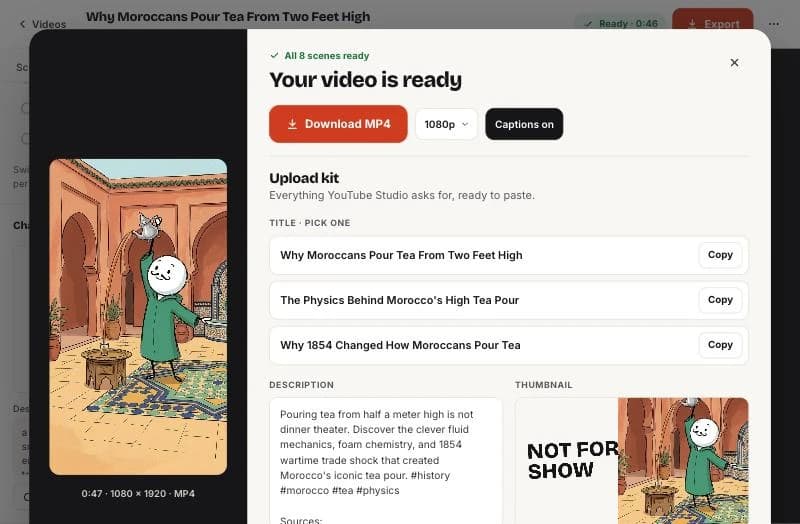
Packaging has three pieces, and each should carry different information: the title asks the question, the thumbnail shows the strange object or moment, and the first spoken line adds a new detail. When all three say the same thing, two of them are wasted.
Write the three together, not one after another. Start from the strangest fact in your research, then decide which piece carries the number, which carries the picture and which carries the surprise. Here are four complete sets.
| Title | Thumbnail shows | First spoken line |
|---|---|---|
| Why a penny costs almost 4 cents to make | A stick figure feeding a penny into a machine, coins spilling out the back. Words: "LOSING MONEY" | "In 2024, every penny cost the US Mint 3.69 cents to make and ship." |
| Oxford is older than the Aztec capital | A stone college gate next to a lake city, with an arrow pointing backward. Words: "WHICH CAME FIRST?" | "Oxford was teaching students more than 200 years before the Aztecs founded their capital." |
| Why you can hear your name across a noisy room | A stick figure at a crowded party, head turning, one speech bubble glowing orange. Words: "HOW?" | "Your brain is ignoring almost every voice in the room. Almost." |
| Vikings didn't wear horned helmets. So who gave them horns? | A Viking stick figure with horns, and a big orange X. Words: "FAKE" | "No Viking Age text ever mentions a horned helmet. The horns showed up in the 1800s." |
Should Shorts titles be different from long-form titles?
Yes, because they do different jobs. On long-form, the title and thumbnail usually earn the click before the video plays. In the Shorts feed, the video starts on its own, so the first spoken line and first picture do the selling and the title mostly works as a label.
That label still matters. It shows in search, on your channel page and when people share the Short, and it tells YouTube what the video is about. Write Shorts titles as the plain question the video answers, and save clever wording for the hook.
| Question | Long-form | Shorts |
|---|---|---|
| What earns the view? | Title and thumbnail, before playback | First second of picture and sound |
| Best title style | Curious, front-loaded, one clear promise | The plain question, easy to search |
| Can you A/B test it in Studio? | Yes, up to 3 versions | No, not at this time |
| How to learn what works | Run a test on each important upload | Compare title patterns across 10 or more Shorts |
How do you test YouTube titles?
For long-form videos, YouTube has a built-in test. The A/B test titles and thumbnails help page says you can test up to 3 titles, 3 thumbnails or 3 combinations, and the version with the highest watch time is shown to everyone. Tests usually finish within two weeks, run only from YouTube Studio on a computer, and need advanced features turned on.
There are limits worth knowing before you plan around it. The same page says Shorts, scheduled live streams and Premieres can't be tested at this time, and the feature isn't available on videos that are made for kids, made for mature audiences or private. If no version clearly wins, the first one you uploaded stays.
The winner is picked by watch time, not clicks, so a title that pulls clicks from the wrong viewers can lose to a calmer one that brings the right viewers.
- Write ten titles using at least four different patterns from the table above.
- Cut to three: one "why" question, one comparison or number, and your wildcard.
- Check each against the first spoken line. Drop any title the video doesn't pay off within the first minute.
- For long-form, run the three in Test and compare and leave them alone; changing the title or thumbnail mid-test stops it.
- For Shorts, note which pattern each title used, and after ten uploads compare how many viewers chose to view versus swiped away.
What title mistakes hurt explainer channels most?
Most weak explainer titles describe the topic instead of the surprise. They read like a library label. The fixes below keep the same video and only move the strangest true detail into the title.
- Keep the jargon for the description. Use "the cocktail party effect" inside the video and description, where curious viewers will learn and search it.
- Drop series labels from the front. "Episode 12" helps nobody decide to click. Put series names at the end or in a playlist.
| Weak title | Problem | Rewrite |
|---|---|---|
| Eiffel Tower facts | A category, no gap. | Why the Eiffel Tower needs 60 tons of paint |
| The Anglo-Zanzibar War explained | Assumes the viewer knows the name. | The war that lasted less than an hour |
| SHOCKING truth about pennies!! | Shouting and vague; promises drama, names nothing. | Why a penny costs almost 4 cents to make |
| History of Oxford University (Full Documentary) | Long, generic, the twist is missing. | Oxford is older than the Aztec capital |
| What is the cocktail party effect? | Psychology | Episode 12 | Jargon first, and labels eat the space. | Why you can hear your name across a noisy room |
YouTube title checklist for explainer videos
Run each title through this list before you publish. It takes a minute.
- Concrete: it names a person, place, object, animal or number.
- Gap: it contains something a typical viewer would not expect.
- True at both ends: if a source gives a range, the title is true for all of it.
- Front-loaded: the first six or seven words make sense alone.
- Paid off: the video answers the title, and the first line adds a new detail.
- Not repeated: the thumbnail words and the title don't say the same thing.
- Calm: no all caps, no "shocking", no "you won't believe".
Questions
How many characters can a YouTube title have?
YouTube allows up to 100 characters in a video title. Long titles get cut off in many places, so put the subject and the surprising detail in roughly the first 40 characters and treat everything after that as optional.
Should I put keywords in my YouTube title?
Put the words a viewer would actually say, like "Eiffel Tower" or "penny", near the front. For explainers, the plain subject is usually the keyword already. Avoid stuffing extra terms or tags into the title; they push the interesting part out of view.
Can I change a YouTube title after publishing?
Yes. You can edit a title any time in YouTube Studio. If a long-form video is in an A/B test, changing its title or thumbnail stops the test, so wait until it finishes.
Can you A/B test YouTube Shorts titles?
Not with YouTube's built-in tool. Its help page says Shorts, scheduled live streams and Premieres can't be tested at this time. Instead, compare title patterns across ten or more Shorts and look at how many viewers chose to view rather than swipe away.
Are question titles good for YouTube?
For explainers, often yes, because a "why" question matches how people search and promises an answer. They work best when the question is specific and strange, like "Why does a penny cost almost 4 cents to make?", and weakest when generic, like "What is history?"
Make your first stickman video
StickTale is in private beta. Join the waitlist and we’ll send your invite as soon as a spot opens.