Scripting
How to Explain Complex Topics Simply: Analogies, One Idea per Scene and Plain Words

By the StickTale team
· 10 min read
To explain a complex topic simply, decide the one idea the viewer should leave with, show a concrete example before the general rule, use an analogy that shares the real mechanism, and name technical terms only after you've shown what they mean. In a video, give each scene exactly one idea. Below is why experts struggle with this, how to test an analogy, and a worked example that turns a dense paragraph about GPS into eleven scenes.
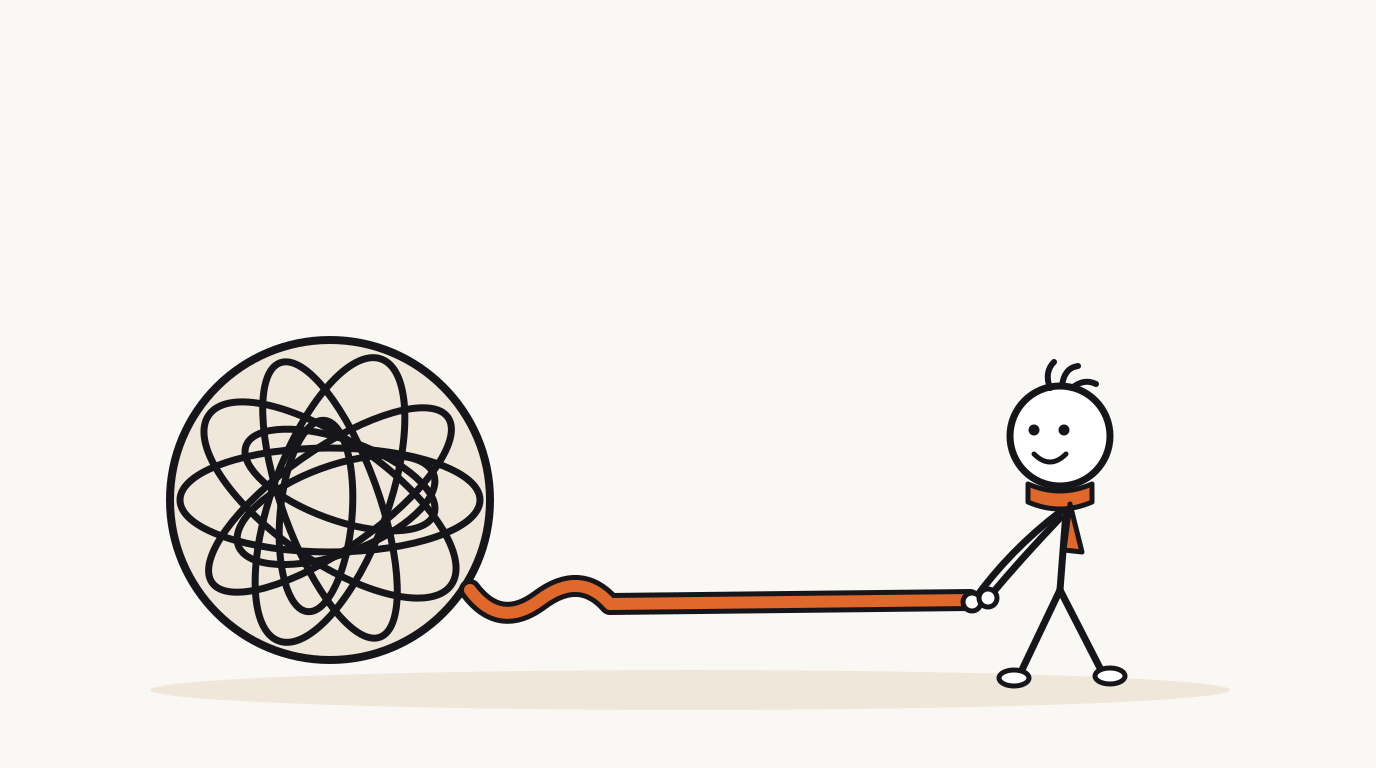
Why is it so hard to explain something you understand well?
Because you can't easily un-know it. In a 1990 study at Stanford, Elizabeth Newton asked people to tap out the rhythm of well-known songs for a listener to guess. Across 120 tapped songs, listeners named only 3, a 2.5 percent hit rate, while the tappers had expected listeners to get about half.
The tappers heard the melody in their heads; the listeners heard knocking. This is the curse of knowledge, and it is the main reason expert explanations go wrong. The steps you skip feel obvious because you took them years ago.
For a script, the practical fix is to stop trusting your own sense of clarity. Read the draft to someone outside the topic and ask them to explain it back. Wherever their version breaks, you skipped a step.
How do you find the one idea a video should explain?
Complex topics feel complex because they contain many true things. A good explanation picks one of them as the destination and treats the rest as optional. Learning research backs this up: one of Richard Mayer's multimedia principles is that people learn better when extraneous words, pictures and sounds are left out rather than included.
Write the answer as one sentence a 12-year-old could repeat. Then list the facts a viewer needs to believe that sentence. Usually it's three or four. Everything else, however interesting, belongs in another video.
- Question: "How does GPS know where I am, and why does it need Einstein?"
- One-sentence answer: "Satellite clocks tick at a slightly different speed up there, and if GPS didn't correct for it, your location would drift by kilometers a day."
- Facts it needs: GPS works by timing signals; tiny timing errors become big distance errors; clocks in orbit run at a different rate; the correction.
- What waits: orbital mechanics, how atomic clocks work, the history of the system, other satellite networks.
Why go concrete before abstract?
An abstract definition asks the viewer to hold a rule with nothing to attach it to. A concrete example gives them the thing first, so when the rule arrives, it labels something they already understand. In a video, concrete also means drawable: you can't illustrate "purchasing power", but you can draw a $10 bill buying less.
The pattern is: a moment or object, then what it shows, then the term. Here it is across four niches.
| Topic | Abstract first | Concrete first |
|---|---|---|
| Inflation | "Inflation is a general rise in prices that reduces purchasing power." | "A $10 bill in your drawer buys a little less each year you leave it there. That shrinking is inflation." |
| Working memory | "Working memory has limited capacity." | "Try holding a new phone number in your head while someone asks you a question. That struggle is your working memory filling up." |
| Feudalism | "Feudalism was a hierarchical system of land and obligation." | "A farmer works a lord's fields. In return, the lord's soldiers protect his village. Stack that deal all the way up to the king, and you have feudalism." |
| Time dilation | "Clocks at different gravitational potentials tick at different rates." | "Put one clock on your desk and an identical one on a GPS satellite. By tomorrow, they disagree." |
How do you choose a good analogy?
An analogy borrows something the viewer already understands to carry something they don't. Weak analogies share the look ("an atom is like a solar system"); strong ones share the mechanism, so the viewer's intuition about the familiar thing gives the right answer about the new one.
Run three tests on every analogy. Does the viewer already know the familiar thing well? Does it work the same way in the part that matters? And where does it break? Say the break out loud in one sentence, or a sharp viewer will say it for you in the comments.
| Concept | Analogy | Shared mechanism | Where it breaks |
|---|---|---|---|
| GPS ranging | Counting seconds between lightning and thunder | Delay tells you distance. | GPS signals travel at light speed and you need several satellites, not one storm. |
| Compound interest | A snowball rolling downhill | Growth adds to the base, so growth speeds up. | Real rates change, and fees can shrink the ball. |
| Vaccines | Showing guards a wanted poster before the intruder arrives | Recognition is learned in advance. | For some diseases, protection fades and needs a booster. |
| Working memory | A small desk that holds only a few papers | New items push old ones off. | Grouping items into chunks lets you hold more, which a desk can't show. |
How do you cut jargon without dumbing it down?
Dumbing down removes ideas. Cutting jargon keeps the idea and removes the barrier in front of it. The goal is not to avoid technical terms forever, since viewers need the real words to look things up later, but to never use a term before the viewer knows what it points at.
This matches another of Mayer's principles: people learn better when they already know the names and characteristics of the main concepts. In a video, the cleanest way is show, then name: describe the thing in plain words with a picture, then say "scientists call this..." and put the term on screen as a label.
- One new term per minute, at most. Each one costs the viewer effort.
- Never introduce two terms in one sentence.
- Keep the plain word once you've chosen it. Switching between "clock drift", "time offset" and "dilation" makes viewers think they're three things.
| Jargon | Plain version first | Name it? |
|---|---|---|
| Trilateration | "Your phone measures its distance from several satellites and finds the one spot that fits all of them." | Optional. The idea matters more than the word. |
| Gravitational time dilation | "Clocks in weaker gravity tick a little faster." | Yes, once, as a label. Viewers will search it. |
| Liquidity | "How fast you can turn something into cash without losing value." | Yes, if the video is for investors. |
| Cognitive load | "How much your brain is juggling at once." | Yes, it's widely used by teachers. |
Why should each scene carry only one idea?
Viewers can't pause a narrator mid-sentence to reread. If a scene carries two ideas, the picture can only show one of them, and the other is gone. At a new picture every ~5 seconds and a calm 150 words a minute, each scene has room for about 12 words, which is about one idea.
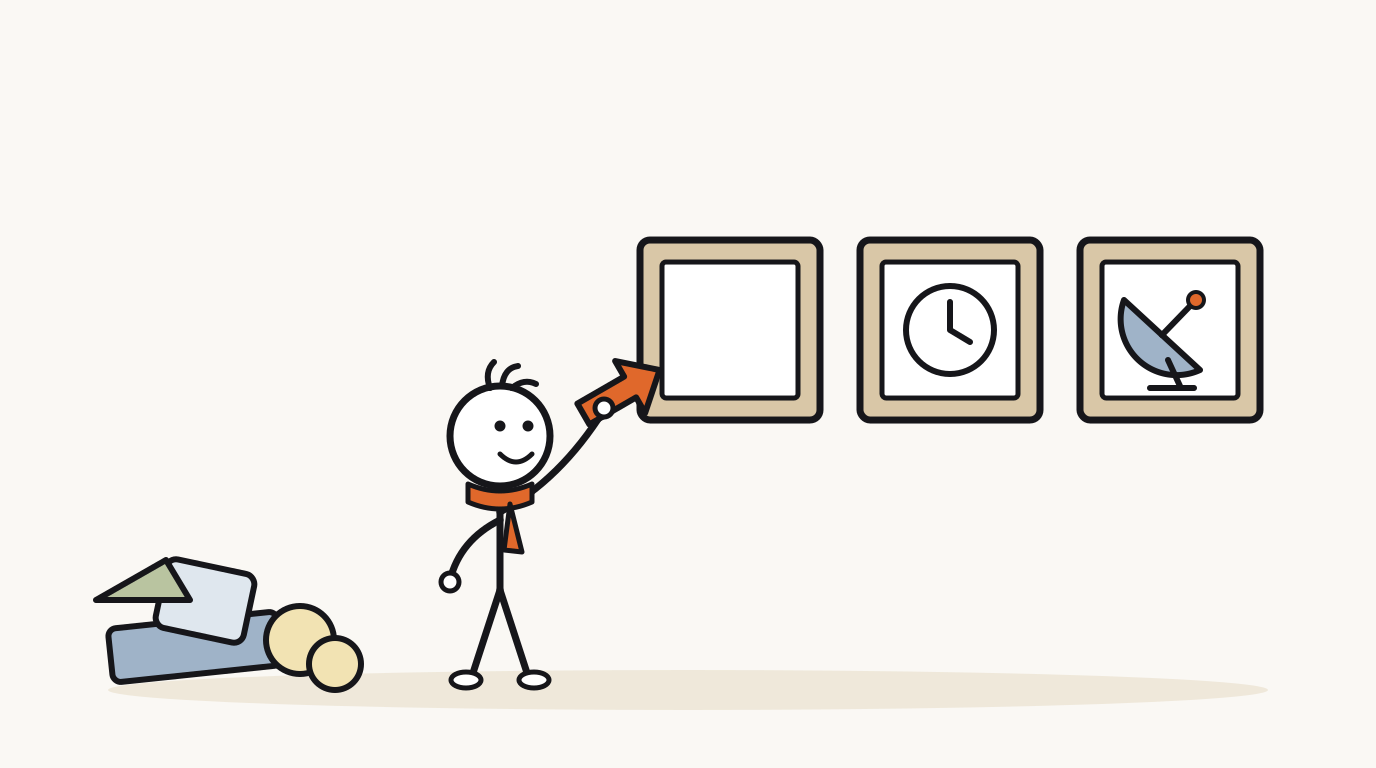
Mayer's work also supports adding cues that highlight the organization of the essential material. In a stick-figure explainer, that cue is the hand-lettered label: one to three words that name the idea of the scene, so it survives even with the sound off. For the timing side of this, see explainer video pacing.
Worked example: turning a dense paragraph into scenes
Here is a paragraph written the way a textbook might put it, using figures from Ohio State astronomer Richard Pogge's GPS explainer: "GPS positioning relies on trilateration from the timing of signals broadcast by satellites carrying atomic clocks. Orbiting about 20,000 km up at about 14,000 km/h, the satellites' clocks run slow by about 7 microseconds per day due to special relativity, but fast by about 45 microseconds per day due to general relativity, owing to weaker gravity. The net offset of about 38 microseconds per day must be corrected, or positional errors would accumulate at about 10 km per day."
It is accurate and nearly impossible to follow by ear. The rewrite keeps every fact but changes the order: consequence first, then the mechanism in one-idea steps. Two numbers are derived so the viewer can feel the scale. Light travels about 300,000 km a second, so in a billionth of a second it covers about 30 cm, and in 38 millionths of a second about 11.4 km, which is why the error grows by roughly 10 km a day.
- Line 1: the consequence, stated as a stake for the viewer.
- Lines 2 to 4: the mechanism, with the thunder analogy carrying "timing becomes distance".
- Line 5: a derived number that makes "precise timing" concrete.
- Lines 7 to 9: one effect per scene, so "+45" and "-7" never share a picture.
- Line 11: the callback to Einstein from line 1.
Why your phone's map needs Einstein
- 10 KMWithout Einstein, your phone's map would be off by about 10 kilometers by tomorrow.
- 20,000 KM UPHere's how GPS finds you. Satellites about 20,000 kilometers up keep broadcasting the time.
- Your phone hears several of them and checks how late each signal arrives.
- LATE = FARLate means far. Like counting the seconds between lightning and thunder.
- 30 CMBut these signals travel at the speed of light: about 30 centimeters in a billionth of a second.
- So the clocks have to be almost perfect. And up there, time doesn't tick at quite the same speed.
- -7The satellites move fast, about 14,000 kilometers an hour. That slows their clocks by about 7 millionths of a second a day.
- +45But they also sit in weaker gravity, which speeds their clocks up by about 45 millionths a day.
- +38Net result: they run about 38 millionths of a second fast, every day.
- In that time, light travels more than 10 kilometers. That's how far off your map would drift.
- So the system corrects for it, and Einstein rides along every time you open a map.
Checklist: is your explanation simple enough?
Run the draft through this list, then do the explain-it-back test with a real person. If you teach, the same checks work for classroom videos; see explainer videos for teachers.
- You can state the answer in one sentence a 12-year-old could repeat.
- The first scene is a concrete moment, object or consequence, not a definition.
- Every analogy shares the mechanism, and you say where it breaks.
- No term appears before the viewer has seen what it means.
- Each scene carries one idea in about 12 words, with a one-to-three word label.
- Every number is either sourced or derived with the math shown.
- Someone outside the topic can explain it back to you.
Questions
What is the best way to explain a complex topic?
Start from the one sentence you want the viewer to remember, open with a concrete example or consequence, add the mechanism one step at a time, and introduce technical terms only after showing what they mean. Then test it by asking someone to explain it back.
What is the curse of knowledge?
The difficulty experts have in imagining what it's like not to know something. In Elizabeth Newton's 1990 tapping study, tappers expected listeners to name about half the songs; listeners named 3 of 120.
How do you make an analogy that works?
Pick something your audience already knows well that works the same way in the part that matters, not just one that looks similar. Use it for one step, then say where the comparison stops being true.
Is simplifying the same as dumbing down?
No. Dumbing down removes ideas or makes them less true. Simplifying keeps the idea and removes the barriers in front of it: unexplained terms, missing steps and too many ideas at once.
How much information should one video scene contain?
One idea. At a new picture every few seconds and a calm narration pace, that is about 12 words per scene. If a line needs two pictures to make sense, split it into two scenes.
Make your first stickman video
StickTale is in private beta. Join the waitlist and we’ll send your invite as soon as a spot opens.