Platform & money
YouTube Shorts vs Long Form: Which Should an Explainer Channel Make?

By the StickTale team
· 10 min read
For most explainer channels the answer is both, with different jobs: Shorts get your ideas in front of strangers fast, and long-form videos turn the people who care into watch hours, ad revenue and a library that keeps working. If you can only make one, pick by goal: Shorts to test topics and reach people, long-form to earn on the watch page and reach the YouTube Partner Program through watch hours. Below is how the two formats differ, how they feed each other, what each costs to make, and a decision table.

What is the difference between YouTube Shorts and long-form videos?
The obvious difference is shape and length. YouTube treats a square or vertical video of up to three minutes as a Short; anything longer or horizontal is a regular video, often called long-form. The less obvious difference is how each one is found, judged and paid, and that is what should drive your choice.
A Short appears in a feed the viewer swipes through, so YouTube's key Shorts metric is stayed to watch: "the percentage of times viewers stayed to watch past the initial seconds of a Short." A long video is usually chosen from a thumbnail, so its first test is impressions click-through rate, how often viewers watched after seeing the thumbnail.
| Question | Shorts | Long-form |
|---|---|---|
| Shape and length | Square or vertical, up to 3 minutes | Horizontal, or longer than 3 minutes |
| How viewers find it | Mostly the swipeable Shorts feed | Thumbnails in Home, search and suggested videos |
| First test | Stayed to watch past the first seconds | Thumbnail click-through rate |
| Ad revenue to the creator | 45% of revenue allocated from the Creator Pool | 55% of net revenue from watch-page ads |
| Extra ad breaks | None | Mid-rolls on videos 8 minutes or longer |
| Path into YPP (with 1,000 subscribers) | 10 million qualified Shorts views in 90 days | 4,000 qualified watch hours in 12 months |
| Navigation | None; viewers watch it whole or swipe | Chapters let viewers jump between sections |
Discovery or watch time: what does each format do for an explainer channel?
Think of Shorts as the shop window and long-form as the shop. A 50-second Short on one strange detail can reach people who have never heard of your channel, because the feed serves it to them without a click. But it holds them for under a minute, and Shorts Feed views never count toward the 4,000 watch hours you need for the YouTube Partner Program.
Long-form works the other way around. It needs a thumbnail and title strong enough to earn the click, which is harder for a new channel. Once someone clicks, though, a 10-minute explainer can hold them ten times longer than a Short, and good explainers keep being found through search for topics people look up again and again.
YouTube's own analytics guidance makes the same point from the data side: "Audience behavior is different across formats, therefore success may look different," so it recommends comparing videos of the same type. Don't judge a long video by Shorts numbers, or the reverse.
- Pick Shorts first when nobody knows your channel yet and you need to learn which topics people stop for.
- Pick long-form first when your topics need explanation, not just a reveal, and you already know people search for them.
- A topic suits a Short if one surprising fact and its reason fit in about 125 words.
- A topic suits long-form if it has a cause, a sequence of events and a consequence, each worth a chapter.
How do Shorts and long-form videos feed each other?
They only feed each other if you build the bridge on purpose. In a July 2026 guide on its official blog, YouTube describes Shorts audiences as segmented: some people only watch Shorts, some want a short version of something longer, and some browse Shorts to find new channels. Your Shorts will reach all three, and the first group is the least likely to click through.

The bridge has three parts. First, add a related video to the Short in YouTube Studio, which shows viewers a clickable link below your channel handle; it needs advanced feature access, and the linked video must be public or unlisted. Second, YouTube's guide suggests a verbal and visual call to action in the Short's final five seconds. Third, the long video should address the Short's promise in its first 5 to 10 seconds, so the click feels rewarded.
A Short's last lines and the long video's first lines, built as one bridge
- 20 BOATSSo the Titanic carried more lifeboats than the law required.
- HALFAnd they still held barely half the people on board. The full story of how the rules fell that far behind is linked below.
- 1,178 SEATS(Long video, first line) In 1912, the Titanic followed the lifeboat rules and still had lifeboat seats for only about half the people on board.
- 10,000 TONSThe rules weren't ignored. They were written for ships a fraction of its size. Here's how that happened.
How much more work is a long-form explainer than a Short?
You can estimate the effort from word counts. At a calm narration pace of about 150 words a minute, a 50-second Short is about 125 words, and a 10-minute video is about 1,500. In the stickman style, with a new picture about every 5 seconds, that is 10 pictures for the Short and 120 for the long video.
The bigger cost is research. A Short usually rests on one or two claims you must verify. A 10-minute explainer can easily carry 20 or more, each of which a commenter can check, and it needs a structure that holds attention across chapters. Our guide to writing an explainer video script covers that structure.
| Format | Narration words | Pictures | Claims to verify (typical) | Extra steps |
|---|---|---|---|---|
| 50-second Short | about 125 | 10 | 1 to 3 | Hook, captions |
| 3-minute Short | about 450 | 36 | 4 to 8 | Avoid claimed music |
| 8-minute video | about 1,200 | 96 | 15 to 20 | Thumbnail, chapters, mid-roll placement |
| 10-minute video | about 1,500 | 120 | 20 to 30 | Thumbnail, chapters, mid-roll placement |
How does each format make money, according to YouTube?
As of October 2026, the two formats are paid in different ways. On long-form, YouTube pays partners 55% of net revenue from ads on their public videos' watch pages, and videos of 8 minutes or longer can carry mid-roll ads. On Shorts, ad revenue from the Shorts feed is pooled each month, the Creator Pool is divided by each creator's share of engaged views, and creators keep 45% of what is allocated to them.
The entry paths differ too. With 1,000 subscribers, a channel can join YPP with 4,000 qualified watch hours in 12 months or 10 million qualified Shorts views in 90 days. For an explainer channel, the watch-hour path is often the more reachable one. Here is the arithmetic, using an assumed 3-minute average view duration; put your own number in.
YouTube's official blog has also announced a change taking effect February 1, 2027: Shorts ads and subscription revenue sharing will go to creators with 10 million qualified Shorts views over the last 90 days, while channels below that remain in YPP and keep earning on long-form. New applicants will need 8,000 qualified watch hours in 365 days or 20 million qualified Shorts views in 90 days. The details are in our guide to YouTube Shorts monetization.
- 4,000 watch hours is 240,000 minutes.
- At a 3-minute average view duration, that is 240,000 ÷ 3 = 80,000 long-form views in 12 months, or about 6,700 a month.
- 10 million Shorts views in 90 days is about 111,000 views a day, every day, for three months.
- Under the announced 2027 entry rule, 8,000 hours at the same 3 minutes is 160,000 views a year, about 13,300 a month.
Which should you make? A decision table by goal
Pick your main goal for the next three months, then read across. Most explainer channels end up in the last two rows: a long-form core with Shorts as the way in.
| Your goal | Lead with | Support with | Measure |
|---|---|---|---|
| Find out which topics people stop for | Shorts | Nothing yet | Stayed to watch, compared across your last 10 Shorts |
| Get your first subscribers | Shorts | One long video per series, linked from each Short | Subscribers gained per Short |
| Reach YPP through watch hours | Long-form, 8 to 12 minutes | Shorts that link to it | Watch hours and average view duration |
| Earn ad revenue under the 2027 rules | Long-form | Shorts for reach | Watch-page revenue, RPM |
| Build videos people find through search for years | Long-form with chapters | Shorts on single questions | Search traffic, views after 90 days |
| Teach one topic fully, for a class | Long-form with chapters | A Short as a homework teaser | Average percentage viewed |
| You only have a few hours a week | Shorts, in batches | One long video a month | Output you can sustain |
How do you make both without doubling your work?
Research once, publish several times. A 10-minute explainer usually contains two or three details strong enough to stand alone as a Short, and the research and fact-checking are already done. The Shorts then send viewers back to the long video that explains everything.
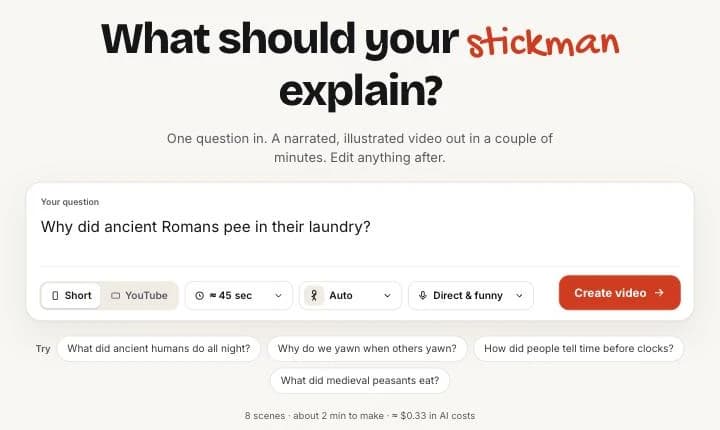
In StickTale, the same question can be made as a 9:16 Short or a 16:9 YouTube video, at lengths from about 45 seconds to 10 minutes, with the same character in both. That makes the long-video-plus-Shorts plan cheap to try for a faceless YouTube channel.
- Pick one question with a cause, a sequence and a consequence, and research it once.
- Make the long video first, 8 to 12 minutes, with chapters at each turn of the story.
- Mark the two or three most surprising details in the script. Each becomes a Short of about 125 words.
- End each Short with one line that points to the bigger question, and set the long video as its related video.
- Make sure the long video opens on that same promise within its first 10 seconds.
- After four weeks, open the Viewers across formats report and check how many Shorts viewers also watch your videos.
Questions
Is it better to post Shorts or long videos on YouTube?
It depends on the goal. Shorts are better for reaching new viewers and testing topics; long videos are better for watch time, watch-page ad revenue and reaching YPP through watch hours. Most explainer channels do best with long videos as the core and Shorts as the way in.
Do YouTube Shorts views count toward the 4,000 watch hours?
No. YouTube's YPP page says watch hours from Shorts views in the Shorts Feed don't count toward the 4,000 qualified watch hours threshold. Shorts have their own path: 10 million qualified Shorts views in 90 days, plus 1,000 subscribers.
Do Shorts hurt long-form views on the same channel?
YouTube hasn't published a rule saying they do, and its own July 2026 blog guide encourages linking Shorts to long videos. What is true is that some Shorts viewers only watch Shorts. Check the Viewers across formats report in YouTube Studio to see how much your audiences overlap.
How long should a long-form explainer video be?
Long enough to explain the topic without padding. Videos of 8 minutes or longer can carry mid-roll ads, so 8 to 12 minutes is a common target, but a padded video loses viewers, and average view duration matters more than length.
How long can a YouTube Short be?
Up to three minutes, in a square or vertical format. For explainers, 45 to 60 seconds is easier to hold, and Shorts over one minute are blocked if they get an active copyright claim, so be careful with music.
Make your first stickman video
StickTale is in private beta. Join the waitlist and we’ll send your invite as soon as a spot opens.